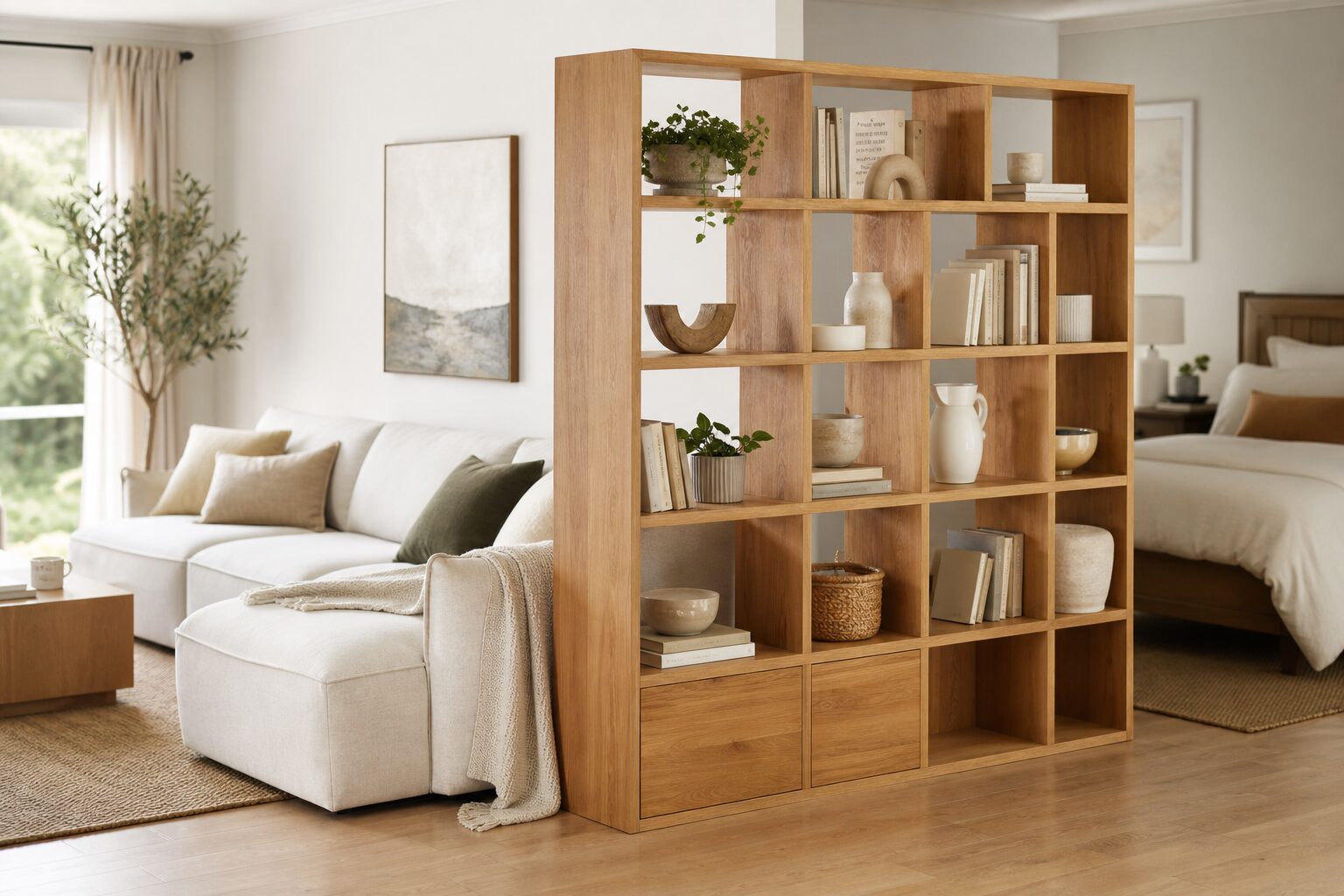
My sister moved into a one-bedroom apartment last year with a living space that ran straight into her “study corner” — really just a desk shoved against the window. She wanted a wall. A builder quote for a stud wall came back at $2,800 and would’ve taken her natural light with it. What she ended up with instead was a book cabinet room divider, and eighteen months on she still tells people it was the best furniture decision she’s made in that flat.
That’s the thing about a book cabinet room divider with shelving storage — it does a job a wall can’t. It splits a room, holds your books and boxes, and still lets light move through the gaps. Here’s why it’s worth considering before you call a builder or buy another flat-pack bookshelf that just sits against a wall doing nothing clever.
1. It Splits a Room Without Boxing It In
Open-plan living and one-bedroom apartments are the norm in most Australian cities now, and the biggest complaint I hear is “there’s no separation between anything.” A solid wall fixes that but kills the open feel you paid for. A shelving unit with a mix of open cubbies and closed sections does the same job — desk on one side, lounge on the other — while light and sightlines still pass through the gaps.
The Book Cabinet Room Divider with Shelving Storage is built for exactly this. It’s freestanding, double-sided in how it’s used, and tall enough to read as a proper divide rather than “just a bookshelf someone dragged into the middle of the room.”

2. Storage That Actually Earns Its Floor Space
A wall gives you nothing back. A divider like this gives you shelving on both faces — books, folders, baskets, a printer, kids’ art supplies, whatever the room needs hidden or displayed. In an apartment where every square metre costs something, furniture that does double duty (divider plus storage) is the only kind worth buying.
3. Cheaper Than Renovating, and You Can Take It With You
Stud walls, plastering, painting — that’s a few thousand dollars and it’s permanent. If you rent, it’s not even an option without a very understanding landlord. A furniture divider costs a fraction of that, needs no council approval, and moves with you to the next place. My sister’s has now lived in two apartments and will probably see a third.
4. Open Shelves Keep the Room Feeling Bigger Than It Is
Solid partitions make small rooms feel smaller because your eye stops at the wall. A shelving divider with open sections lets your eye travel through the gaps to the window or the far wall, so the room reads as one continuous space even though it’s functionally two zones. This is the trick stylists use in studio apartments and it genuinely works — I’ve tested it in my own place by shelving my rental bookcase against nothing versus pulling it out as a divider, and the room photographed bigger both times with the divider.
5. It Suits More Than One Room
People assume “room divider” means living room, but this style earns its keep in a few spots:
- Splitting an open living/dining area without a wall
- Creating a home office nook in a bedroom or spare corner
- Separating an entry hallway from the main living space so guests aren’t looking straight into your lounge
- Backing onto a bed as a headboard-height divider in a studio
3 Styles Worth Looking At
Not every bookcase makes a good divider — you want something with enough depth and height to feel intentional, and ideally a mix of open and closed storage so it doesn’t look like a wall of books from one side and a mess from the other.
The Purpose-Built Divider
The Book Cabinet Room Divider with Shelving Storage in warm brown is the obvious starting point — it’s designed to stand in the middle of a room rather than hug a wall, with a mix of shelving and enclosed cabinet space so you can hide the printer cables and still display the books you actually want people to see.
The Industrial Option for a Lighter Look
If your space is already dark or north-facing light isn’t reaching the back of the room, go lighter. The Industrial Design White Bookcase (60x35x123cm) works well as a lower-profile divider — at 123cm it still separates a desk nook from a living zone without going full floor-to-ceiling, and the white finish bounces light back through the room instead of absorbing it.

The Tall, Warm-Wood Statement Piece
For a bigger room where you want the divider itself to look like a feature, the 6-Tier Solid Oak Wood Bookcase (52x22x180cm) is worth a look. Solid oak has real weight and grain to it — it doesn’t feel like a temporary fix, it feels like furniture that’s meant to stay. At 180cm it reads as a genuine partition rather than a bookshelf that happens to be in the middle of the room.

How to Actually Set One Up as a Divider
A few things I’d tell anyone doing this for the first time:
- Measure the walk-through gap. Leave at least 80-90cm either side so it doesn’t feel like squeezing past furniture every day.
- Mix open and closed storage front-to-back. Books and decor facing the living side, baskets or boxes facing the desk or hallway side, so both zones look considered.
- Anchor it if you’ve got kids or pets. Freestanding units this tall should be secured to the wall behind them with an anti-tip strap, even mid-room — most come with the hardware, just use it.
- Don’t overfill one side. A divider loaded heavier on one face can look (and feel) unbalanced from the room. Spread weight and visual bulk across both faces.
Is It Worth It Over a Bookshelf Against the Wall?
If storage is your only need, a wall-hugging bookshelf is simpler. But if you’re also trying to solve a layout problem — an open-plan living zone, a desk that needs its own corner, a hallway that bleeds straight into your lounge — a book cabinet room divider solves two problems with one piece of furniture, at a fraction of the cost and effort of building a wall. That’s really the whole case for it: less commitment than renovating, more use than a shelf that just sits there.