
A customer messaged us last month convinced her floating bedside cabinet would rip straight out of the wall the first time she rested a full glass of water on it. She’d read a forum post from 2016 and decided every wall-mounted piece was a disaster waiting to happen. She’s not the only one. We hear versions of this same worry every week, so let’s sort out what’s actually true.
Myth 1: Floating bedside cabinets can’t hold real weight
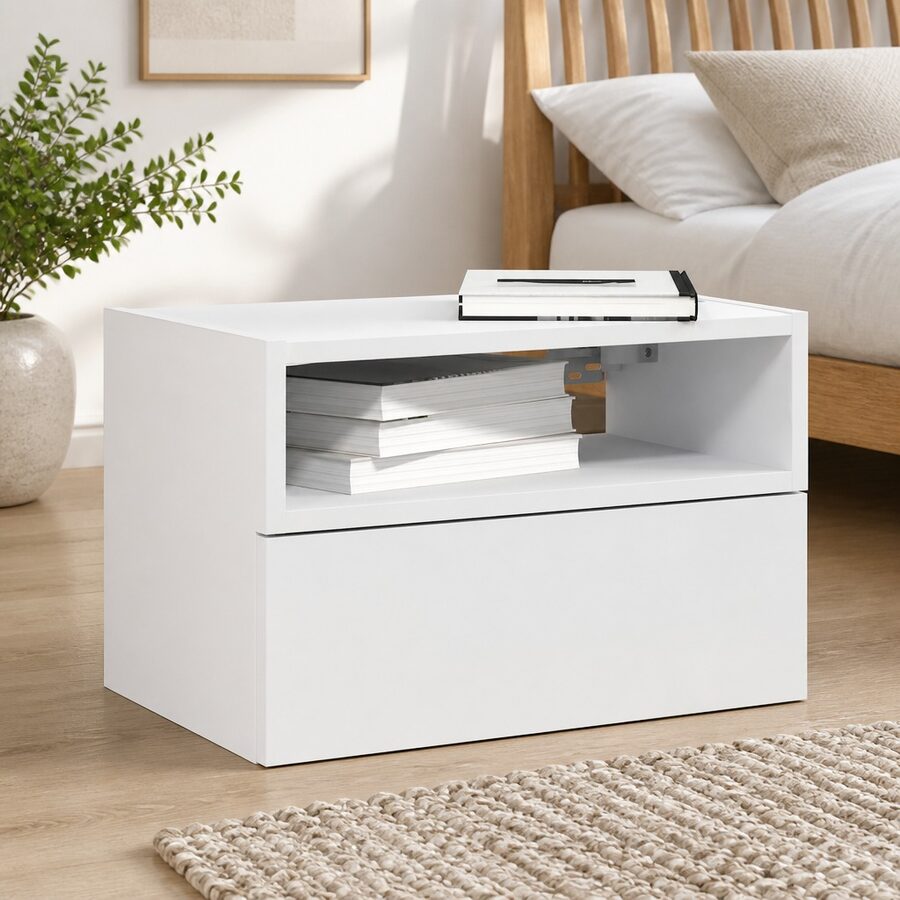
This is the big one. People picture a flimsy shelf held on with a couple of screws and imagine it collapsing under a lamp, a book stack and a phone charger. In reality, a properly mounted floating cabinet uses a French cleat or heavy-duty bracket system fixed into wall studs (or with the right anchors into plasterboard), and most quality units are rated to hold 15-25kg comfortably. The Floating White Bedside Cabinet with Drawer and Shelf is built with a solid engineered timber frame, not particleboard offcuts, so a lamp, a stack of paperbacks and a water glass sit on it every night without a wobble.
The real failure point isn’t the cabinet, it’s the installation. Screwing into hollow plasterboard with no anchor is asking for trouble. Screwing into a stud, or using proper wall anchors rated for the load, solves the problem entirely.
Myth 2: You need to drill a dozen holes and patch the wall later
Most floating bedside units mount with two to four fixing points, not the scaffold of holes people imagine. The bracket sits flush against the wall and the cabinet slides or hooks onto it, so from install to done you’re usually looking at 20 minutes with a drill, a level and a pencil mark. If you’re renting and genuinely can’t drill, that’s a fair reason to skip floating designs altogether and go with a freestanding option instead, like the White Wooden Bedside Cabinets with Storage Features, which gives you the same warm white finish and drawer storage without touching the wall.
What installation actually involves
- Marking stud positions with a stud finder (or using the anchors supplied if fixing to plasterboard)
- Levelling the bracket and securing it with the provided screws
- Hanging the cabinet body onto the bracket, which usually clicks or slides into place
- Fitting the drawer front and shelf, if they arrive separately for flat-pack shipping
Myth 3: Floating means less storage than a normal bedside table
People assume “floating” is code for “tiny shelf with nothing in it.” Not the case. The floating cabinets we stock still include a full drawer plus an open shelf underneath, so you get the same practical storage as a standard freestanding bedside table: room for chargers, glasses case, hand cream, a book or two. The difference is what’s happening underneath the cabinet, not inside it. Because the base is lifted off the floor, you can see clean floorboard or carpet all the way to the skirting, which makes a small bedroom read as bigger and makes vacuuming or mopping under it genuinely easy instead of a fight with a nozzle attachment.
Myth 4: They only suit ultra-modern, minimalist bedrooms
This one probably comes from seeing floating cabinets photographed in stark white rooms with nothing else in them. But a soft white floating cabinet with rounded edges sits just as comfortably next to a linen headboard and warm timber floor as it does in a sleek apartment. It’s a shape decision, not a style straitjacket. If you like the idea of the wall-mounted look but want a pair either side of the bed rather than a single piece, the Wall-Mounted Bedside Cabinets for Storage – 2 pcs gives you a matching set, which tends to suit couples who each want their own drawer and shelf.

Myth 5: They’re not worth it if you might move house
Fair worry, but not quite right. Most brackets unscrew from the wall in a few minutes, leaving two to four small holes that a bit of filler and touch-up paint sorts out in an afternoon. Compare that to the scuffed skirting boards and dented walls that come from dragging a heavy freestanding bedside table in and out of a moving van, and the floating option often comes out ahead. If you move a lot though, it’s worth being honest with yourself. A freestanding cabinet that just gets picked up and carried is simpler if you’re the type who changes address every twelve months.
Where a floating cabinet genuinely earns its spot
- Small bedrooms where floor space next to the bed is tight and every visible centimetre of floor matters
- Bedrooms with a low, wide bed frame where a tall bedside table would sit awkwardly above mattress height
- Renters with landlord approval for wall fixtures, or homeowners happy to drill into a stud
- Anyone who wants easier robot-vacuum access or just hates dust bunnies collecting under furniture

What to actually check before you buy one
Skip the marketing photos and look at three things: the weight rating stated by the maker, whether the bracket kit includes stud-and-plasterboard anchors, and the drawer runner type (metal runners with a soft-close mechanism last far longer than plastic glides). A cabinet that ticks those three boxes will outlast the cheap ones that generate the horror stories in the first place.
Our customer with the water-glass worry ended up going with the floating drawer version after we walked her through the bracket spec. Her wall has three fixing points into a stud, and six months on, nothing’s budged. Sometimes the myth just needs a straight answer, not a guess.