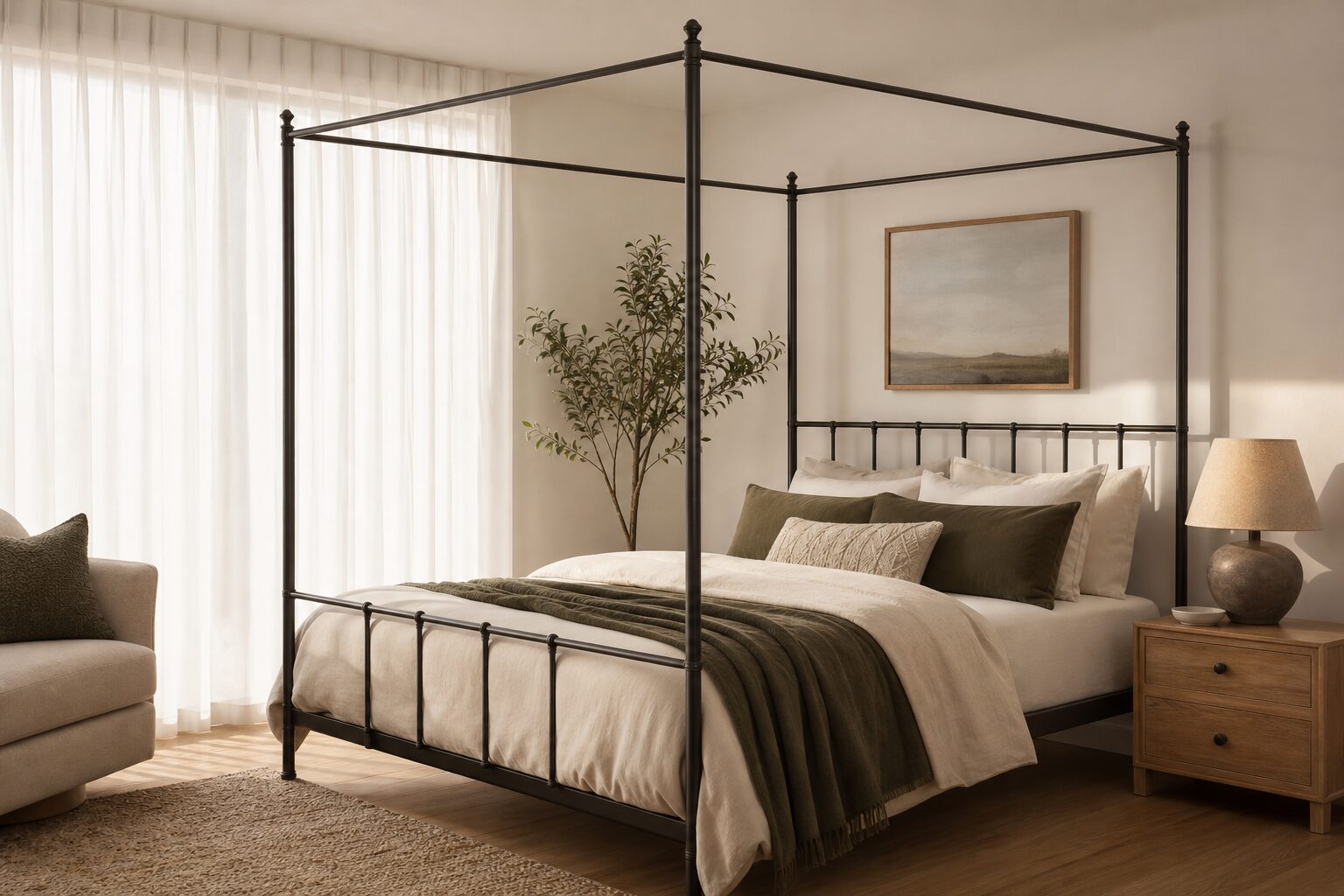
A customer messaged us last month torn between two beds for her rental in Brunswick. One was a black steel four-poster with a canopy top, the other a storage bed with USB ports built into the headboard. Her room was small, her phone charger cord was always tangled somewhere under the mattress, but she’d wanted a four-poster since she was a teenager. That’s the actual tension most people face with double bed frames — the bed you want to look at versus the bed that solves your daily annoyances.
So here’s a straight comparison of three double bed frame types we sell a lot of: the double-sized metal four-poster canopy frame, a metal storage bed with USB charging, and an engineered wood frame in Sonoma oak. Same job, three very different ways of doing it.
Four-Poster Canopy Bed: Statement Piece, Simple Structure
The black steel four-poster canopy frame is the one people photograph. Four upright posts, a top rail connecting them, and a slim, industrial silhouette that reads more like a piece of architecture than a bed. It works best in rooms with at least 2.4 metre ceilings, otherwise the posts feel cramped against the cornice.
Structurally it’s straightforward — powder-coated steel tubing, welded joins, slats supported on a centre rail so you don’t need a box spring. No storage, no upholstery, nothing to stain or vacuum. That’s actually the appeal for a lot of buyers: it’s a bed you can wipe down with a damp cloth in ten seconds.
Where it falls short is practicality. There’s no headboard storage, no shelf for your glasses or phone charger, and if you like draping fabric over the canopy (a lot of our customers do — a length of linen or muslin softens the black steel nicely) you’re adding another job to set up. It’s also not the bed for someone wanting to disguise mess under the frame; the open base means whatever’s under there is on display.

Storage Bed with USB Charging: Built for Small Rooms and Busy Nightstands
The metal storage bed with LED headboard and USB charging solves almost the opposite problem. Instead of being decorative, it’s doing double duty as storage and tech. The headboard itself has shelving or compartments (depending on configuration) and built-in USB ports, so your phone charges without a power board balanced on the bedside table.
This is the frame we recommend for apartments, share houses, or anyone who’s tired of nightstand clutter. If you read in bed on your phone or tablet before sleeping, having the charging point in the headboard rather than reaching across to a wall socket is a small thing that makes a real difference every single night.
The trade-off is visual. It’s a busier design than the four-poster — more surfaces, more hardware, sometimes LED strip lighting that some people love and others find gimmicky (the lights are usually switchable, worth checking before you rule it out). It also sits lower and boxier in a room, so it won’t give you that soaring, dramatic look the canopy frame does.
Engineered Wood Frame: The Middle Ground
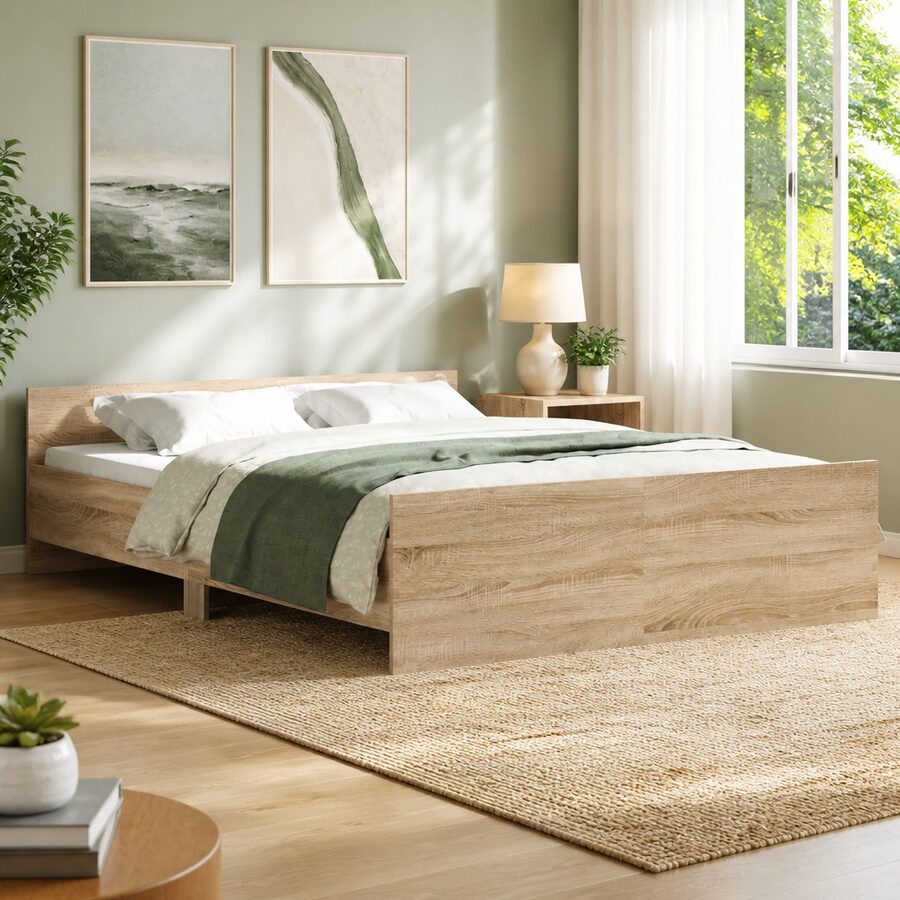
The 135x190cm Sonoma oak engineered wood bed frame sits between the two. It’s got a proper headboard and footboard, so it feels more finished and cosy than open steel tubing, but no storage compartments or tech built in. Just a warm, timber-look frame that suits a broader range of interiors — Scandinavian, warm minimalist, traditional, even a slightly rustic bedroom.
Engineered wood (particleboard or MDF with an oak-look laminate finish, in this case) is heavier than steel but more forgiving on knocks and scuffs than you’d think — it doesn’t dent the way thin veneer sometimes does. It won’t feel as architectural as the four-poster, and it doesn’t solve clutter the way the storage bed does, but it’s the easiest of the three to match with existing furniture, especially if you already have oak-toned bedside tables or a chest of drawers.
Comparing Them Side by Side
- Best for small apartments or share houses: the storage bed with USB charging — it does more work in less floor space.
- Best for a statement bedroom or higher ceilings: the four-poster canopy frame — nothing else in this category makes a room feel as intentional.
- Best for blending with existing furniture: the Sonoma oak engineered wood frame — warm tones suit most colour schemes.
- Easiest to clean and maintain: the metal four-poster, since there’s no fabric or storage crevices to worry about.
- Best for tech-heavy sleepers: the storage bed, hands down.

What About Assembly and Mattress Fit
All three take a standard double mattress (137 x 190cm), so you’re not locked into anything unusual there. The metal frames — both the four-poster and the storage bed — typically bolt together with an allen key in under an hour if you’ve got a second pair of hands for the headboard. The engineered wood frame takes a little longer, mostly because the panels are heavier and need care not to chip the laminate edges while tightening cam bolts.
None of them need a base or box spring underneath — all three use slats rated for a standard double mattress, whether that’s memory foam, latex or a pocket-spring hybrid.
Our Honest Take
If we’re being upfront: most people choosing between these three already know which one they want emotionally, and are looking for permission to buy it. The four-poster is for the room you want to feel like a retreat. The storage bed is for the room that needs to work harder than it looks like it should. The oak frame is for the person who just wants a good-looking bed that doesn’t fight with the rest of the house.
There’s no wrong answer here, just a mismatch if you buy the wrong one for your space. Measure your ceiling height before committing to the canopy frame, and measure your nightstand real estate before ruling out the storage bed. Both save you regret later.