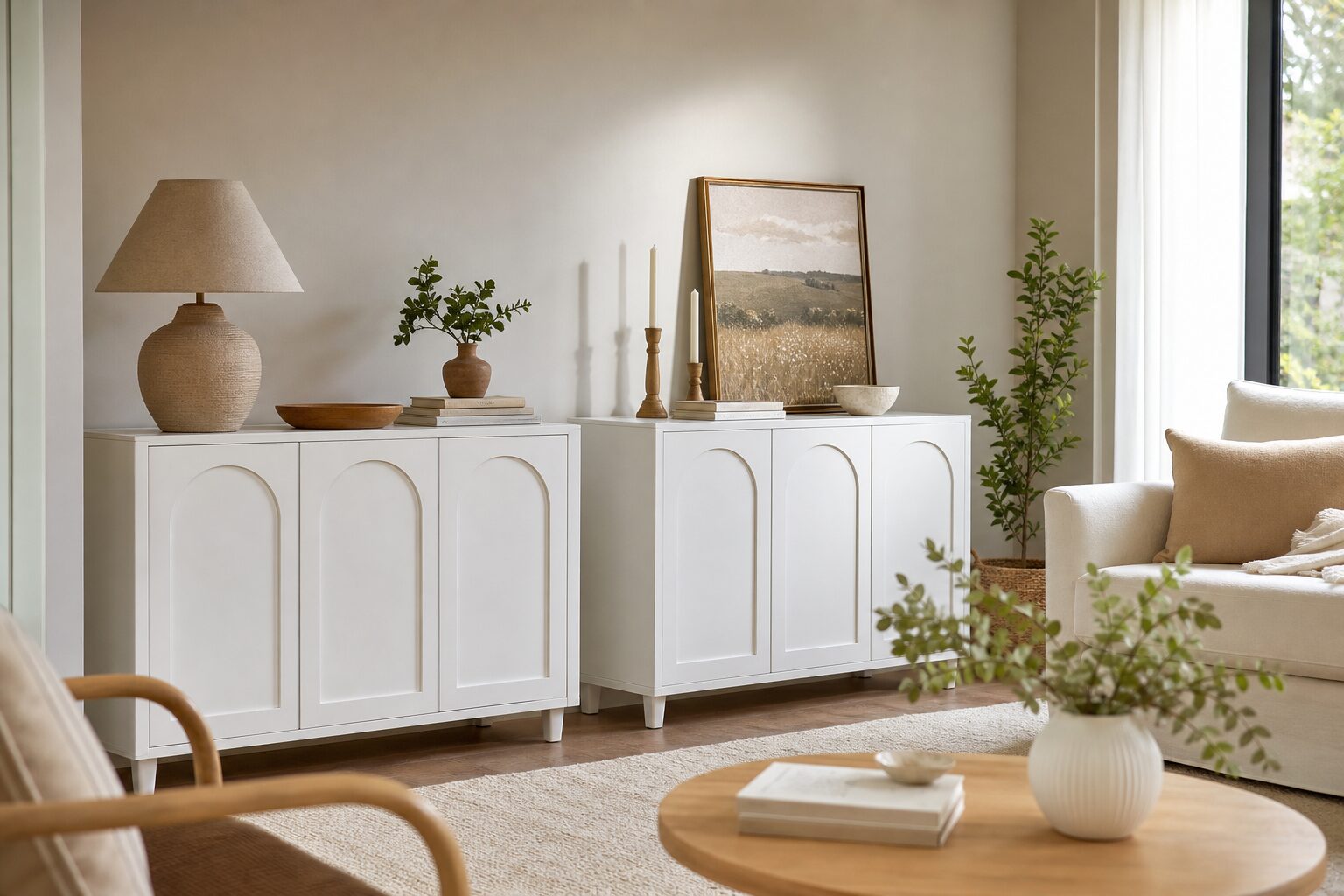
A customer emailed us last month with a floor plan attached. Her dining room had a doorway on one wall, a window on another, and a narrow stretch of wall on each side of the room that could barely fit anything wider than 90cm. She’d been hunting for “one long sideboard” for weeks and kept striking out. The fix wasn’t a bigger cabinet. It was two smaller ones.
This happens more than you’d think in Australian homes, especially older weatherboards and terrace houses where dining rooms weren’t built with a single unbroken wall in mind. A set of 2 engineered wood white sideboards solves that problem without you having to compromise on storage.
Why buy sideboards as a pair instead of one long unit
A single 180cm buffet needs 180cm of clear wall, plus clearance for chairs pulling out and doors swinging open. Most dining rooms in Australian homes don’t actually have that — they have two 80-100cm gaps interrupted by doorways, skirting heaters, or power points.
Splitting your storage into two matching cabinets gets around this. You place one either side of the room, or either side of a serving hatch, and suddenly you’ve got the same total storage without needing an unbroken run of wall. It also means each cabinet is lighter and easier to move on your own — handy if you’re in a rental and might reshuffle furniture between rooms later.
- Fits dining rooms with doorways, windows or heating vents breaking up the walls
- Each cabinet can be moved solo — no need for two people every time you rearrange
- Flexible if you move house: one cabinet can go to the hallway, one stays in the dining room
- Symmetry reads as intentional, not accidental, especially either side of a sideboard mirror or artwork
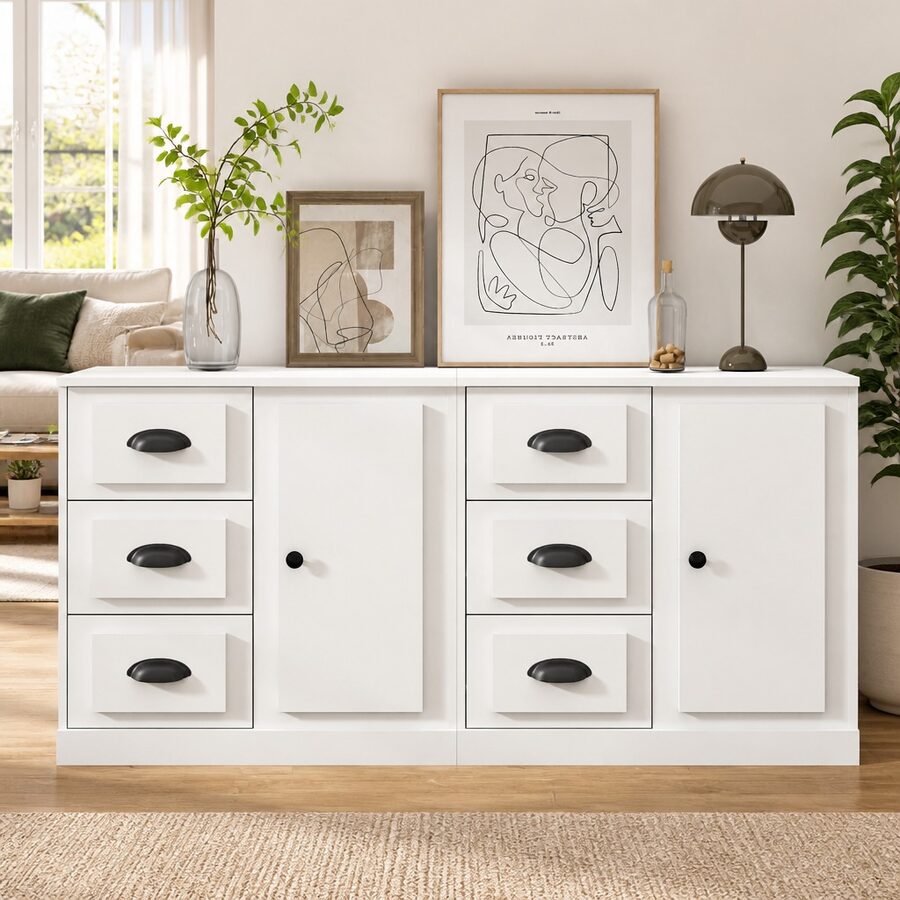
Where the two-cabinet layout actually works
We hear the same three scenarios from Comfia customers again and again.
Open-plan living and dining zones
If your living and dining areas share one long wall, a pair of white sideboards can mark out each zone. One holds crockery and table linen near the dining table, the other stores remotes, coasters and throw blankets near the sofa. Same finish, same handles, but doing two different jobs.
Either side of a doorway or serving hatch
Kitchens with a pass-through to the dining room often have two short wall sections flanking the opening. A matching pair fills both without looking like leftover furniture. It also puts serving dishes within arm’s reach of the kitchen on one side, and everyday dinnerware near the table on the other.
Small dining rooms that need a “his and hers” split
Some households genuinely need to separate stock — one cabinet for glassware and good china that only comes out for guests, one for the everyday stuff that gets used three times a day. Trying to cram both into a single cabinet usually ends in a jumbled mess every time you’re rushing to set the table.
What’s actually inside these cabinets
Each unit in the set of 2 white sideboards is built from engineered wood with a smooth white finish, so they wipe clean easily and don’t show fingerprints the way a matte black finish would. Behind each door you get an adjustable shelf, which matters more than people expect — dinner plates, tall vases, and stacked storage boxes all need different shelf heights, and a fixed shelf almost never suits everything you own.
Assembly is flat-pack, standard Allen key and screwdriver work, and each cabinet goes together in well under an hour if you’ve got the panels laid out first. Because you’re building two identical units, the second one always goes faster once you’ve done the first.
If you want more storage than two cabinets give you
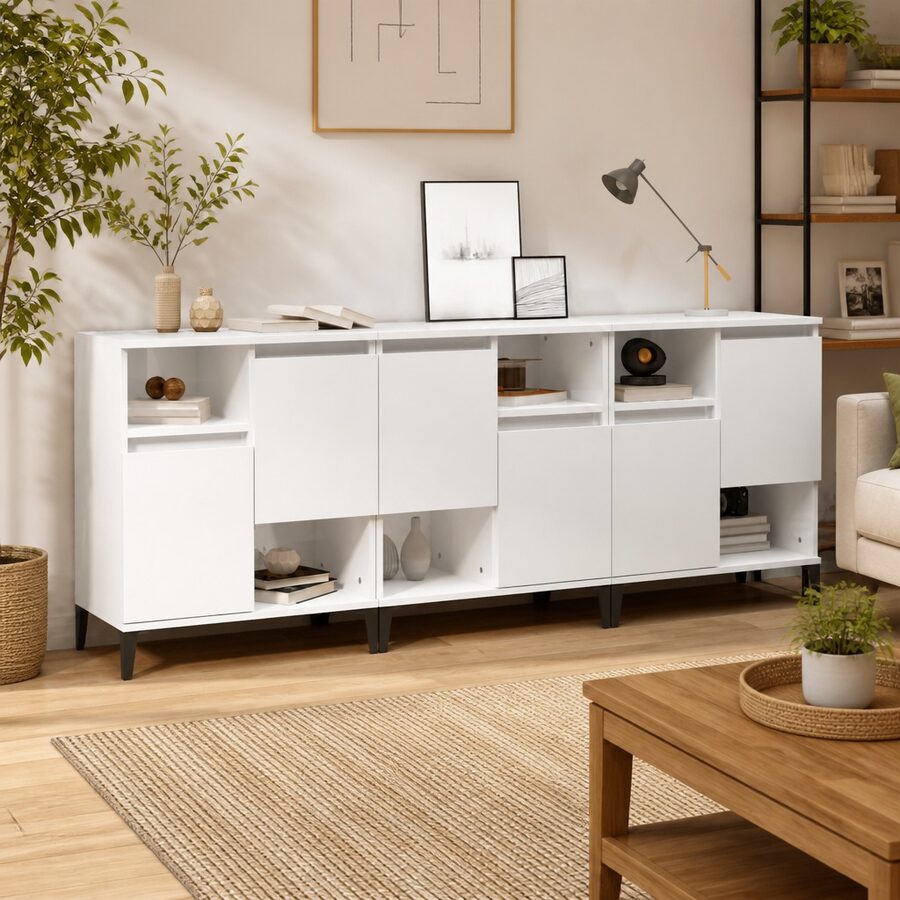
Some dining rooms have the opposite problem — one continuous wall, plenty of room, and a need for serious storage across the whole run. In that case the 3-piece high gloss white storage cabinet set gives you a low run of cabinets you can arrange side by side or spaced apart, with a glossier finish that catches light nicely in rooms without much natural sun.
Mixing white sideboards with a darker anchor piece
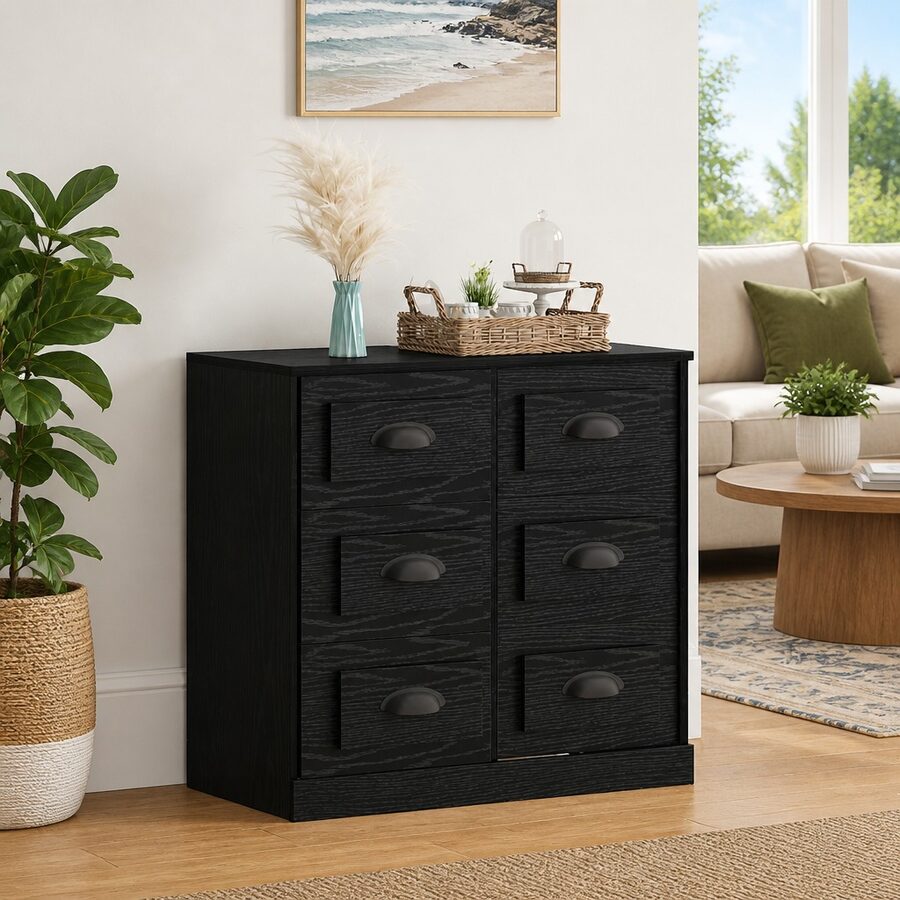
Not every home wants pure white on both walls. A layout we like: keep the pair of white sideboards on the quieter side of the room for everyday crockery and table linen, then use a single black oak 70cm sideboard as a feature piece under a mirror or artwork on the main wall. The contrast stops the room feeling like a matching furniture showroom, and the black oak grain gives the space some warmth against all that white.
Measuring before you buy
Before ordering a set, measure both wall sections you’re planning to use — don’t just measure one and assume the other is identical, because older homes are rarely perfectly symmetrical. Leave at least 5-10cm on either side of each cabinet for door swing and airflow, and check your dining chairs still pull out fully once both cabinets are in place. It’s a small thing people forget until the first dinner party, when someone’s chair won’t push back far enough to stand up.
If you’re furnishing from scratch, buying the pair together also means you’re not left hunting for a “close enough” matching sideboard six months later when the first one’s already faded slightly or been discontinued. You get consistent tone and hardware from day one, which matters more than it sounds once the room’s actually styled and lived in.