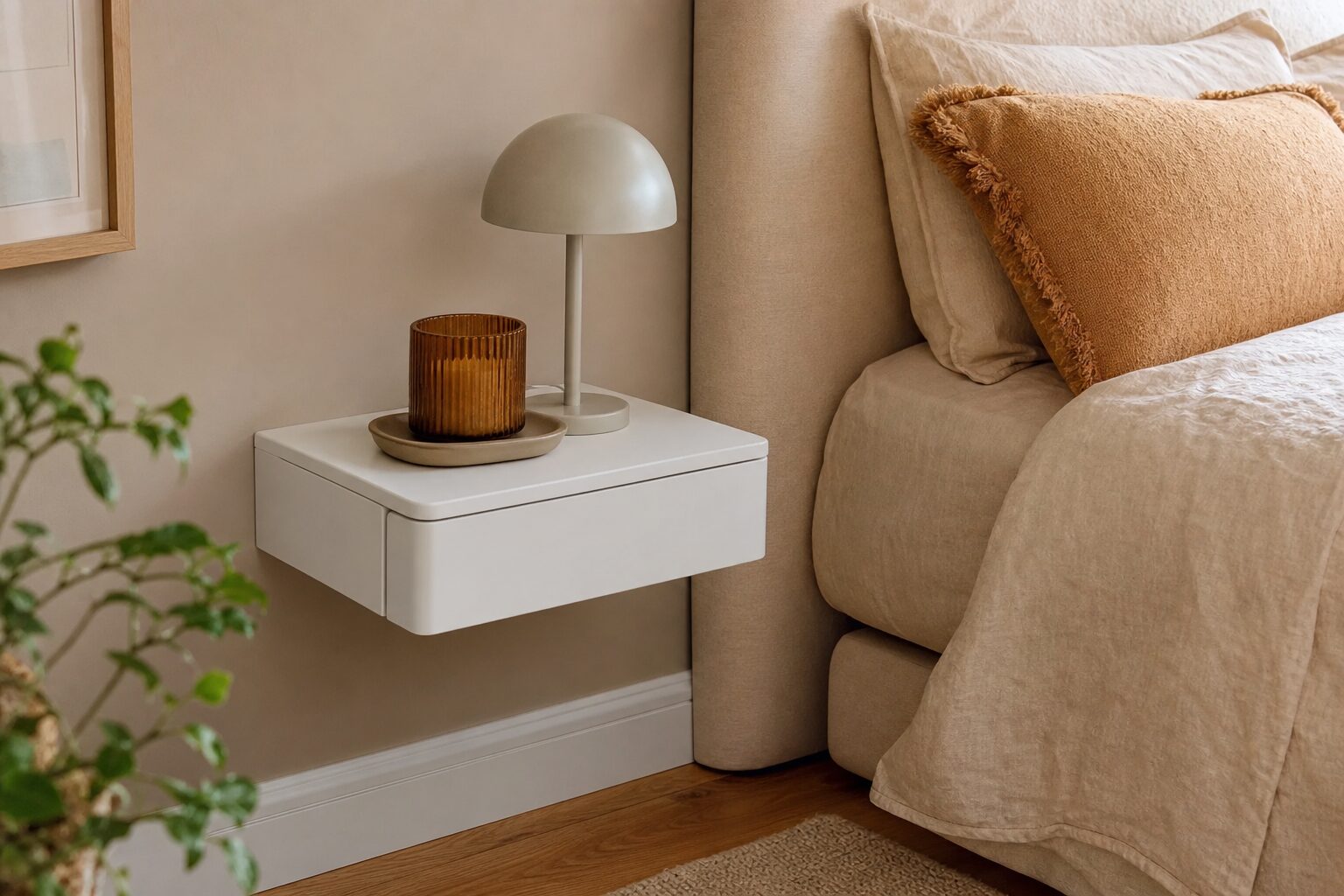
A customer messaged us last month asking if a wall-mounted bedside table would “just fall off in the middle of the night.” Fair question. She’d had a bad experience with a cheap floating shelf in a rental years back, and it had put her off the whole idea ever since. We get versions of this question weekly, so it’s time to sort fact from fear on wall-mounted bedside tables.
If you’ve been eyeing a piece like our Wall-Mounted White Side Table with Storage Drawer but talked yourself out of it because of something you read on a forum, this one’s for you.
Myth 1: Wall-mounted bedside tables can’t hold real weight
People assume “wall-mounted” means flimsy. In practice, a properly installed floating bedside table with drawer support can carry a lamp, a book, a glass of water, a phone and charger without any drama. The weight rating depends on the wall type and the fixings used, not on the fact that it’s mounted rather than legged.
Plasterboard alone won’t hold much, that part’s true. But with the right anchors into a stud, or into brick or concrete with the correct wall plugs, these tables handle daily bedside use fine. We’ve had customers keep alarm clocks, tablets and even small stacks of books on them for years with zero sag.
Myth 2: You need a stud in exactly the right spot
This is the one that puts most people off. Reality: modern wall-mounted units, including ours, come with mounting hardware designed for a range of wall types. If a stud isn’t in the ideal position, heavy-duty toggle or hollow-wall anchors rated for the table’s weight do the job. You’re not stuck if your stud finder comes back empty where you wanted the table.
Our advice, and what we tell customers who call in unsure: measure twice, use a stud finder to confirm what’s behind the plasterboard, and if in doubt about brick or concrete walls, ask a professional to fit it. Ten minutes of care up front means no wobble later.
Myth 3: Floating tables mean no storage
This one’s simply outdated. Older floating shelves were just that, shelves. Current designs pack a full storage drawer into the same wall-mounted footprint. The Wall-Mounted White Side Table with Storage Drawer gives you a drawer for glasses, chargers, hand cream or a book, plus the open top surface for a lamp, all without eating floor space in a small bedroom.

If you want a bit more storage capacity and don’t mind a floor-standing option, the Two-Drawer Oak Nightstand with Open Shelf is worth comparing. Two drawers plus an open shelf underneath suit people who like to keep more within reach.
Myth 4: They’re only for tiny apartments
Wall-mounted bedside tables get pitched as a small-space fix, and they are great for that. But they’re just as useful in a larger main bedroom where you want a cleaner look, easier floor vacuuming, or a bedside spot that doesn’t compete visually with a large bed frame. Plenty of our Melbourne customers with generous bedrooms choose them purely for the streamlined feel, not because they’re short on square metres.
The white finish especially reads calm and uncluttered against warmer timber floors or a linen bedhead, which fits the soft, liveable look most people furnishing a real bedroom are after rather than a showroom-perfect one.
Myth 5: Installation is a nightmare and needs a tradesperson
Most people can mount one of these tables themselves in under half an hour with a drill, a level and the hardware provided. It’s genuinely similar to hanging a heavy mirror or a floating shelf. Where it gets trickier is solid brick or concrete walls, where a masonry drill bit and the right anchors matter. If you’re renting and can’t drill into walls at all, that’s the one scenario where a wall-mounted design isn’t the right fit, and a freestanding option like the Engineered Wood Bedside Cabinet: White Storage Solution makes more sense.

That cabinet gives you the same white, soft-neutral look with a closed storage compartment, sitting straight on the floor with no drilling required, which suits rentals or anyone who moves furniture around often.
Myth 6: Wall-mounted means hard to keep level over time
Some people worry the table will slowly droop or tilt after a few months. If it’s fitted correctly with the right anchors for your wall type and not overloaded beyond a sensible bedside load, it stays level. Occasional re-checking of the screws every year or two, especially in older plasterboard homes, is good practice but not a sign anything’s wrong.
Compare that to a leggy nightstand on carpet, which can wobble if the floor isn’t perfectly flat. In some ways a well-mounted table is more stable, not less.
Which style actually suits your bedroom
A few honest pointers based on what we see customers choose and keep:
- Small bedroom, want the floor clear for a rug or for vacuuming ease: the wall-mounted white table with drawer suits best.
- Renting, or want to reposition furniture without drilling: go freestanding, either the engineered wood cabinet or the oak nightstand.
- Want warmer, more traditional wood tones instead of white: the Two-Drawer Oak Nightstand with Open Shelf brings texture and two drawers of storage plus an open shelf for a stack of books or a basket.
- Sharing a bed with limited wall space beside it but plenty of floor room: freestanding options give you a bit more surface area to work with.

What to check before you buy one
Ask about the maximum load rating, the wall types the hardware suits, and whether the drawer runs smoothly closed (cheap versions sometimes have drawers that stick once loaded). Confirm the drawer depth suits what you actually want to store, phone chargers and hand cream need less depth than a stack of paperbacks.
The customer who messaged us about the falling-off fear ended up going with the wall-mounted white table, fitted into a stud with the anchors provided. Last we heard, it’s holding a lamp, a candle and a paperback with no drama at all. Sometimes the myth is just an old bad experience talking, not the product itself.